
Every lawn starts the same way: someone standing in a store aisle or scrolling a website, staring at a wall of options, wondering which bag will give them that lawn. The dark green, tight-knit, envy-of-the-neighbourhood lawn.
Most pick the bag with the best photo. That decision costs them years.
Here is the uncomfortable truth about grass seed in Canada: the vast majority of seed sold at big-box retailers is commodity-grade. The cultivars inside those bags are selected for one thing: cheap production at scale. Not colour. Not density. Not disease resistance. Not performance in a Winnipeg winter or a Vancouver rain week. Just cost per kilogram.
The seed that builds championship golf courses, professional sports fields, and sod farms uses entirely different genetics. Until recently, those cultivars were locked away in 50-pound commercial bags, sold only through turf supply distributors. A homeowner had no practical way to buy them.
That is changing. And if you are reading this, you are likely the kind of person who cares enough to make a smarter choice.
The single biggest factor in lawn performance is the genetic quality of the seed you plant. Not your mower. Not your fertilizer program. Not your watering schedule. The genetics. This guide will help you identify and choose elite genetics over commodity seed. We will walk through Canada's grass-growing climate zones, break down the four cool-season species that actually thrive here, and show you how to match the right seed to your soil, sun exposure, traffic patterns, and expectations. No hype. No filler. Just the information you need to build a lawn that performs.
Quick Reference: Find Your Seed in 30 Seconds
Know your conditions? Start here. This table matches common Canadian lawn situations to the right seed approach. Read the full guide for the reasoning behind each recommendation.
| Your Situation | Best Species | Seed Strategy | Key Reason |
|---|---|---|---|
| Full sun, want the best-looking lawn possible | Kentucky Bluegrass or KBG/PRG blend | Elite KBG blend for density + colour. Add 20% PRG for faster fill-in. | Rhizome self-repair creates a lawn that improves every season |
| Full sun, kids and pets, heavy foot traffic | Perennial Ryegrass or KBG/PRG blend | PRG-dominant blend for wear tolerance. KBG component adds long-term recovery. | PRG handles immediate traffic; KBG fills divots through rhizomes |
| Partial to heavy shade (under mature trees) | Fine Fescue blend or shade-specific blend | Fescue-dominant blend with shade-tolerant KBG cultivars. Avoid PRG in deep shade. | Fine fescues are the only cool-season grasses that thrive in 4 hrs of sunlight or less |
| Hot summers, drought-prone, clay or compacted soil | Turf-Type Tall Fescue | TTTF blend or mono-stand. Zone 5+ only. Deep, infrequent watering to train roots. | Root depth of 4-6 ft pulls moisture from soil layers other species cannot reach |
| Quick renovation or overseeding an existing lawn | Perennial Ryegrass | Overseed with elite PRG for visible results in 5-7 days. Follow with KBG in year two. | Fastest germination of any cool-season species; instant visual improvement |
| Low-maintenance, cottage, or minimal-input lawn | Fine Fescue (shade) or Turf-Type Tall Fescue (sun) | Shaded lots: fine fescue blend. Sunny lots: TTTF for deep roots and drought tolerance without a watering program. | Both thrive on less input. Fescues tolerate neglect; TTTF survives drought without irrigation. |
| Mixed conditions (sun + shade, variable soil, all-around resilience) | Multi-species blend (KBG + PRG + Fescue) | Total lawn blend with all three species. Each dominates where it performs best. | Genetic diversity = built-in insurance against whatever your yard throws at it |
Canada's Grass Growing Zones: What Your Climate Actually Demands
Canada is a cool-season turf country. From coast to coast, every lawn-growing region falls into what turf scientists call the cool-season grass belt, regions where daytime temperatures during the growing season average between 15°C and 24°C. That is the temperature window where Kentucky bluegrass, perennial ryegrass, fine fescues, and turf-type tall fescue hit their stride.
But "cool-season" is not one climate. A lawn in Southern Ontario faces different stresses than a lawn in Calgary, Moncton, or the Fraser Valley. Understanding those differences is the first step toward choosing seed that will not just survive your region, but thrive in it.
The Five Canadian Lawn Regions
Southern Ontario and Quebec (Plant Hardiness Zones 5–6)
The warmest and most populous lawn-growing region in Canada. Hot, humid summers (regularly 30°C+) test drought and disease tolerance. Cold winters with reliable snow cover protect turf. Key stresses: summer heat, humidity-driven fungal diseases (dollar spot, brown patch), heavy foot traffic in suburban yards. This region supports the widest range of cool-season species, including turf-type tall fescue in warmer microclimates.
There is an important distinction within this region. In the southern parts of Ontario and Quebec (roughly Zone 6 and warmer Zone 5 areas, including the GTA, Hamilton, Niagara, Windsor, and the Montreal/Québec City corridor), perennial ryegrass and turf-type tall fescue perform well as standalone species or dominant blend components. Winters are cold but manageable, and the growing season is long enough for these species to establish strong root systems before freeze-up. As you move into northern Ontario and northern Quebec (cooler Zone 5 and into Zone 4), winter hardiness becomes more of a factor. In those areas, blends that include a meaningful proportion of Kentucky bluegrass and fine fescue provide better insurance against winter kill and ice damage. For a more detailed breakdown of Ontario-specific recommendations by zone and city, see our Ontario grass seed guide (coming soon)
Prairie Provinces: Alberta, Saskatchewan, Manitoba (Zones 2–4)
The harshest test for cool-season turf. Extreme winter lows (-35°C to -45°C), chinook freeze-thaw cycles in Alberta, alkaline soils, and wind desiccation define this region. Key stresses: winter kill, ice damage, low precipitation, clay-heavy or alkaline soils. Winter hardiness is non-negotiable here. Kentucky bluegrass dominates for good reason: its rhizome system recovers from winter damage better than any other species.
One notable exception: the chinook belt of southern Alberta, centred around Calgary and extending south toward Lethbridge. Chinook winds produce warmer winter temperatures and a longer effective growing season compared to the rest of the Prairies. In these areas, perennial ryegrass and turf-type tall fescue become viable options, particularly as blend components alongside a strong KBG base. If you are in the chinook belt and want to push the envelope, a KBG/PRG blend or a KBG-dominant blend with a TTTF component can offer performance that pure bluegrass cannot match. Just know that you are working closer to the winter hardiness edge for those species. For Alberta-specific recommendations including the chinook belt, see our Alberta grass seed guide (coming soon).
British Columbia's Lower Mainland and Vancouver Island (Zones 7–9)
Canada's mildest turf climate. Wet, mild winters and dry summers create a unique dynamic. Grass often stays green through winter but can brown during August dry spells. Key stresses: summer drought, shade from mature evergreen canopy, moss competition, poor drainage in clay soils. Perennial ryegrass and fine fescues excel. Turf-type tall fescue is an outstanding choice here, where deep roots pull moisture through summer dry periods without winter-kill risk. For B.C.-specific recommendations by region, see our B.C. grass seed guide (coming soon).
Atlantic Canada: New Brunswick, Nova Scotia, PEI, Newfoundland (Zones 4–6)
Cool and moist. Shorter growing seasons than Ontario but less extreme winter stress than the Prairies. High rainfall and coastal influence mean consistent moisture but also persistent shade and disease pressure. Key stresses: fog-driven humidity, salt spray near coasts, shorter establishment windows. Fine fescues and Kentucky bluegrass blends perform well. Perennial ryegrass provides fast cover during the narrow seeding windows.
Northern Regions and Transitional Areas (Zones 1–3)
Short growing seasons and extreme cold limit options. Northern Alberta, Northern Ontario, and parts of B.C.'s interior fall here. Key stresses: extremely short establishment windows, permafrost or near-permafrost soils, intense UV. Only the hardiest Kentucky bluegrass cultivars and some fine fescues are viable. Seed selection here is less about preference and more about survival.
The Four Species That Thrive in Canadian Lawns
Cool-season lawns in Canada are built from four grass species (or combinations of them). Each brings different strengths. Understanding those strengths, and their weaknesses, is where good seed selection begins.
Kentucky Bluegrass (Poa pratensis)
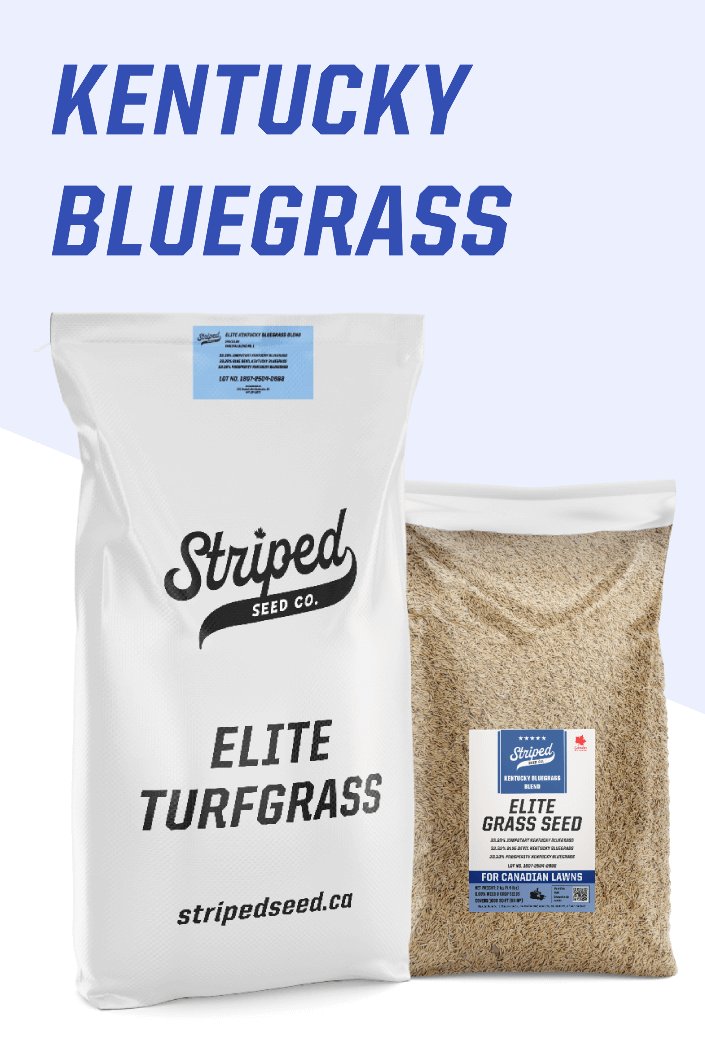
The backbone of premium Canadian lawns. Kentucky bluegrass is the only common lawn species that spreads laterally through underground stems called rhizomes. This self-repair mechanism is what makes it the gold standard for lawns that need to recover from traffic, winter damage, or bare spots. A well-established KBG lawn fills in gaps on its own, no overseeding required.
Strengths: Self-repairing via rhizomes, exceptional cold hardiness, dense upright growth, dark blue-green colour, excellent sod-forming characteristics.
Weaknesses: Slowest germination of the four (14-21 days typical, up to 28), poor shade tolerance, higher fertilizer and water demands, vulnerable to summer dormancy in drought.
Best for: Full-sun lawns across all Canadian regions. The primary species for Prairie lawns. Homeowners willing to invest in maintenance for a premium result.
Perennial Ryegrass (Lolium perenne)
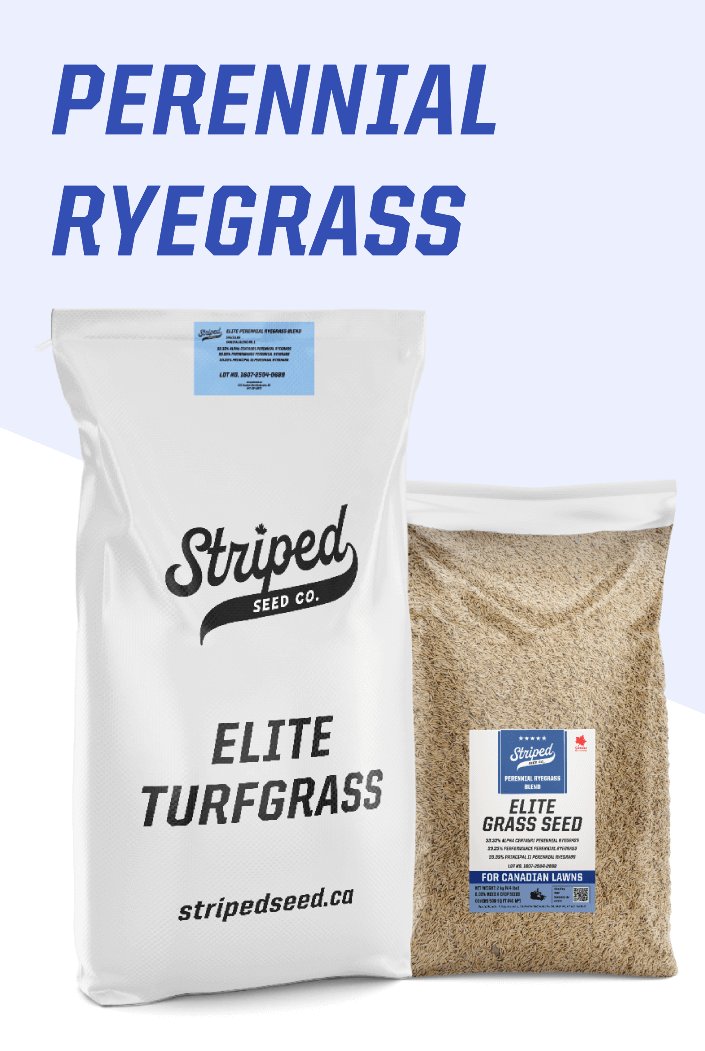
The fastest germinator in the cool-season toolkit. Perennial ryegrass goes from seed to visible sprouts in 4-7 days under good conditions. That speed makes it the go-to species for overseeding thin lawns, filling bare patches, and providing quick colour while slower species establish.
Strengths: Rapid germination, outstanding wear tolerance, fine-bladed texture in elite cultivars, high visual density, emerald green colour with a distinctive gloss.
Weaknesses: Bunch-type growth (does not spread via rhizomes or stolons), moderate winter hardiness (reliable to Zone 4, risk increases in Zone 3 and below), requires consistent moisture during establishment.
Best for: Overseeding existing lawns, quick cover in renovations, high-traffic areas, blending with KBG for faster establishment. Excellent as a standalone lawn in Southern Ontario, B.C., and Atlantic Canada.
Fine Fescues (Festuca spp.)
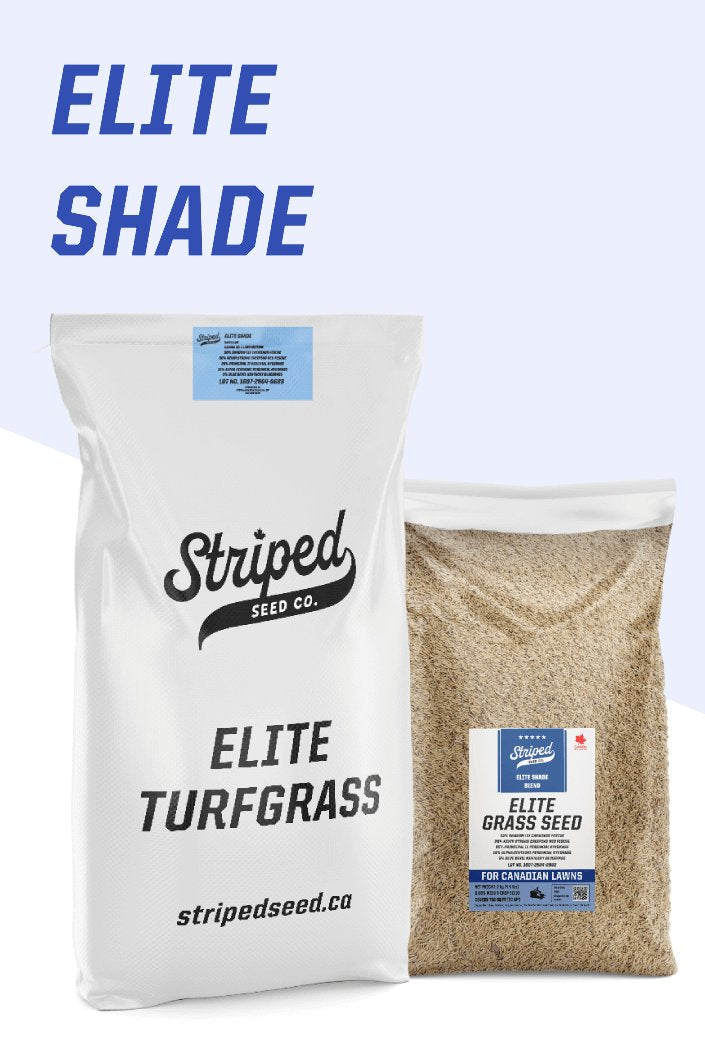
The shade specialists. The fine fescue family, including creeping red fescue, chewings fescue, hard fescue, and sheep fescue, thrives where other species struggle. They tolerate shade, low fertility, acidic soils, and drought conditions that would thin out a bluegrass stand.
Strengths: Excellent shade tolerance (the best among cool-season species), low maintenance requirements, good drought tolerance once established, fine needle-like texture, performs on poor soils.
Weaknesses: Poor traffic tolerance (cannot handle heavy foot traffic), tendency to clump if overseeded into existing lawns, some varieties develop thatch, lighter green colour than KBG or PRG.
Best for: Shaded lawns under mature trees, low-maintenance properties, cottage lawns, areas with acidic soil, mixing into blends for shade adaptation.
Turf-Type Tall Fescue (Festuca arundinacea)
The drought and traffic champion. Modern turf-type tall fescue cultivars bear little resemblance to the coarse, clumpy tall fescue of past decades. Today's elite varieties produce medium-fine leaf blades, deep root systems (reaching 4-6 feet), and exceptional wear tolerance. That root depth translates directly to drought resistance. Tall fescue pulls moisture from soil layers that other species simply cannot reach.
Strengths: Outstanding drought tolerance, excellent traffic tolerance (rated 9/10 in NTEP trials), adapts to a range of soil types including clay, maintains colour through summer heat, moderate shade tolerance.
Weaknesses: Limited winter hardiness compared to KBG (best suited for Zones 5+ with caution in Zone 4), bunch-type growth habit, wider blade than KBG or elite PRG, newer to the Canadian market with less regional performance data.
Best for: Southern Ontario and B.C. lawns where summer drought is the primary stress. Yards with heavy foot traffic or play areas. Properties where deep irrigation is impractical. Low-maintenance lawns in full sun, where its deep root system reduces or eliminates the need for regular watering.
Species Comparison at a Glance
| Trait | Kentucky Bluegrass | Perennial Ryegrass | Fine Fescues | Turf-Type Tall Fescue |
|---|---|---|---|---|
| Germination | 14-21 days | 4-7 days | 10-14 days | 7-12 days |
| Spreading | Rhizomes (self-repairs) | Bunch-type | Varies by sub-species | Bunch-type |
| Cold Hardiness | Excellent (Zone 2+) | Good (Zone 4+) | Very Good (Zone 3+) | Moderate (Zone 5+) |
| Shade Tolerance | Poor | Moderate | Excellent | Moderate-Good |
| Drought Tolerance | Moderate (goes dormant) | Low-Moderate | Good | Excellent (deep roots) |
| Traffic Tolerance | Good (recovers well) | Very Good | Poor | Excellent |
| Maintenance Level | High | Moderate-High | Low | Moderate |
| Mowing Height | 2-3″ (1.5″ for reel) | 1.5-3″ | 2.5-4″ | 2.5-4″ |
Matching Seed to Your Situation
Species knowledge gets you to the right family. But a lawn is not a laboratory. Your specific conditions, including sun, soil, traffic, and goals, determine which species or blend will actually deliver.
Best Grass Seed for Sun vs. Shade in Canada
Full sun (6+ hours direct sunlight): All four species are viable. Kentucky bluegrass and perennial ryegrass will deliver the highest density and colour. This is where premium cultivars shine brightest.
Partial shade (3-6 hours): Fine fescues become essential. A blend that includes creeping red fescue or chewings fescue alongside shade-tolerant KBG cultivars gives you the best chance at a full stand. Pure KBG lawns will thin progressively in partial shade.
Heavy shade (<3 hours direct sun): Fine fescue-dominant blends are your only realistic option. Set expectations accordingly. Even the best shade blend will produce a thinner, softer lawn under dense canopy. Consider whether the area could be better served by shade-tolerant ground cover.
Soil Type: The Hidden Variable
Your soil determines how much of your seed's genetic potential actually gets expressed. Clay soil (common across Southern Ontario, the Prairies, and the Fraser Valley) retains moisture but drains poorly and compacts under traffic. Kentucky bluegrass and turf-type tall fescue handle clay better than perennial ryegrass. Sandy soil (parts of Atlantic Canada, cottage country) drains fast and holds few nutrients. Fine fescues are purpose-built for these conditions. Loam is the ideal. Every species performs well in it.
Before seeding, a basic soil test (available through most provincial agricultural extension offices for $20-40) tells you your pH, organic matter, and nutrient levels. This thirty-dollar test prevents hundreds of dollars in wasted seed and fertilizer.
Traffic and Use
If kids, dogs, or regular foot traffic are part of the equation, wear tolerance and recovery rate are your top criteria. Perennial ryegrass delivers immediate wear resistance. Kentucky bluegrass repairs damage through rhizome growth. Turf-type tall fescue combines both: outstanding traffic tolerance with deep roots that resist compaction. Fine fescues should be a minor component or excluded entirely in high-traffic zones.
Best Grass Seed by Lawn Goal
The premium lawn: You want dark green, dense, tight. The lawn that makes neighbours slow down as they drive past. Kentucky bluegrass or elite perennial ryegrass (or both). You are willing to mow regularly, fertilize on a schedule, and manage irrigation. The payoff is a lawn that looks professional.
The family lawn: You need it to look great and take a beating. A KBG/PRG blend gives you density, speed, and recovery. Add turf-type tall fescue in warmer regions for drought-proof resilience.
The low-maintenance lawn: You want green without the program. In shaded areas, fine fescue blends are your answer, with lower mowing demands, lower fertilizer needs, and tolerance of neglect. In full sun, turf-type tall fescue is the better low-input choice. Its deep root system pulls moisture from well below the surface, meaning it stays green through dry spells without a watering program. The trade-off with fescues is a softer, lighter-coloured lawn; with TTTF, a slightly wider blade.
The renovation: You are fixing an existing lawn that has thinned, been damaged, or was poorly established. Overseeding with perennial ryegrass gives immediate density. Mix in KBG for long-term self-repair, but expect the bluegrass to take a full season to contribute meaningfully.
Seed Certification: Reading the Label Like a Pro
Not all grass seed is created equal, and the label on the bag is your proof. In Canada, grass seed is regulated under the Seeds Act and graded by the Canadian Seed Institute. The certification system has tiers and grades, and they tell you exactly what quality standards the seed has met.
Canada's Seed Certification Tiers
Gold Tag (Certified No. 1): The highest certification tier in the Canadian system. Gold Tag seed meets the most stringent germination, purity, and varietal identity standards. It's unlikely that you would ever encounter a gold CFIA certification tag on a bag of grass seed at the retail level, and most Canadian homeowners have never seen a Gold Tag label on a bag of grass seed.
Blue Tag (Certified No. 2): The professional-grade standard that the lawn enthusiast community recognizes as the benchmark for quality seed. Blue Tag certification means the seed lot has been independently tested, meets strong germination and purity thresholds, and contains named, traceable cultivars. Within the Canadian lawn care community, Blue Tag has become the standard that knowledgeable buyers look for. It signals that the seed inside is not commodity filler but a tested, certified product with verifiable genetics.
Common Seed (No Certification): Identified only by species, not by specific cultivar. No guaranteed performance data, no NTEP testing, no independent certification. This is the majority of what fills the shelves at big-box retailers across Canada.
Grades: What You'll Actually See on the Label
On the label itself, certification tiers appear as grade designations. These are the actual words printed on the bag, and knowing them helps you decode what you're looking at. "Canada Certified No. 1" corresponds to Gold Tag tier, the highest grade a single cultivar or variety can carry. "Varietal Blend No. 1" is a certified blend of named cultivars that have each been individually tested. "Canada No. 1 Lawn Mixture" is a grade that may contain a mix of species but does not require named cultivars or individual varietal testing. Most big-box grass seed bags carry a grade somewhere in the fine print, but without cultivar names alongside it, the grade alone does not tell you much about the genetics inside.
The Retail Reality
Here is the part that most seed guides leave out: the certification system described above exists, but it has been largely invisible to Canadian retail shoppers. Walk into any hardware store or garden centre and pick up a bag of grass seed. You will usually find some small print with a grade and a few general species names (e.g. perennial ryegrass, fescue, etc.) listed on the label, possibly a germination percentage, and not much else. No cultivar names. No CFIA certification tag. Cultivar and grade information has been a black box at the consumer level for years.
This matters because certification and grade is not just a label. It represents a chain of testing, traceability, and quality control that connects the seed in your bag to specific genetics with documented performance. When a bag does not list cultivar names, there is no way to verify what you are actually planting, if it was independently tested, or how it scored across various performance categories.
Seed products that carry a physical CFIA (Canadian Food Inspection Agency) certification tag attached to the bag itself are extremely rare at the retail level. Among widely available Canadian grass seed brands, Striped Seed Co. is the only one with physical CFIA certification tags on their grass seed bags. Both of our individual cultivar products (Alpha Centauri and Southside) carry them. However, all grass seed sold by Striped Seed Co. is certified. The reason some of our products don't carry physical CFIA certification tags is because they're not required for our blended products, and the logistics involved don't justify it. But all of our products are labelled with a grade and list the individual cultivars in the bag. And we go a step further by providing cultivar National Turfgrass Evaluation Program (NTEP) performance data on all of our product pages.

What to Look for on the Bag
The single most practical indicator of seed quality available to a retail shopper is whether the bag lists specific cultivar names (e.g., "Alpha Centauri Perennial Ryegrass"), not just a species name like "Perennial Ryegrass." Named cultivars have traceable genetics and performance records. They also mean you can look up the cultivar's performance data through the National Turfgrass Evaluation Program (NTEP), a university-run research network that tests cultivars across dozens of locations over multiple years. Cultivars are scored on a 1-9 scale for turf quality, disease resistance, colour, density, and other metrics. A cultivar ranked in the top 20 of its species nationally has demonstrably superior genetics to an untested commodity variety. If the bag doesn't name the cultivars, none of this verification is possible.
Blends vs. Single Cultivars: When Diversity Wins
You will see two types of seed packaging: single-cultivar and blends. Both have a place. The choice depends on what you are trying to build and how much variability your site has.
Why Blends Exist
A blend combines multiple cultivars of the same species (e.g., three Kentucky bluegrass cultivars) or multiple species (e.g., KBG + PRG + fine fescue). The biological logic is simple: genetic diversity creates resilience. If one cultivar is susceptible to a disease or stressor that hits your lawn, the others compensate. The result is a stand that adapts to microclimate variations across your property: the sunny strip along the driveway, the shaded patch under the maple, the compacted area near the gate.
When a Single Cultivar Makes Sense
Monoculture lawns, one cultivar wall to wall, produce the most uniform appearance. Every blade matches in colour, texture, and growth rate. If visual consistency is your top priority and your conditions are uniform (full sun, irrigated, well-maintained), a single elite cultivar can deliver a striking result. The trade-off is fragility: a single disease or pest that targets that cultivar has no backstop.
Multi-Species Blends: The Canadian Advantage
Canadian properties are rarely uniform. Most have a mix of sun and shade, areas of varying traffic, and soil that changes across the lot. A multi-species blend, like a KBG/PRG combination or a KBG/PRG/Fine Fescue three-way, lets different species dominate in the microclimates where they perform best. The perennial ryegrass germinates fast and holds the line while Kentucky bluegrass slowly fills in beneath it. Fine fescues colonize the shaded margins. Over two to three seasons, the lawn self-sorts into the strongest possible stand for each zone of your property.
Seeding Rates and Timing: The Numbers That Matter
Under-seeding produces a thin lawn that lets weeds establish. Over-seeding wastes money and creates a dense mat of seedlings that compete for resources, producing weak plants. Getting the rate right matters as much as choosing the right seed.
Recommended Seeding Rates
| Species | New Lawn (per 1,000 sq ft) | Overseeding (per 1,000 sq ft) | Coverage per kg |
|---|---|---|---|
| Kentucky Bluegrass | 1.0-1.8 kg (2.2-4.0 lbs) | 0.9-1.4 kg (2.0-3.1 lbs) | ~550-1,000 sq ft |
| Perennial Ryegrass | 3.2-4.0 kg (7.0-8.8 lbs) | 2.0-3.2 kg (4.4-7.0 lbs) | ~250-310 sq ft |
| Fine Fescue (shade blends) | 2.5-3.5 kg (5.5-7.7 lbs) | 2.0-3.0 kg (4.4-6.6 lbs) | ~285-400 sq ft |
| Turf-Type Tall Fescue | 3.5-4.5 kg (7.7-9.9 lbs) | 2.3-3.2 kg (5.1-7.0 lbs) | ~220-285 sq ft |
Note: Blends will have a combined rate that falls between the component species. Check the specific product label for the manufacturer's recommended rate. Rates shown are per 1,000 sq ft. Use the lighter end for thickening up a decent lawn, and the heavier end for repairing thin or patchy areas.
When to Plant Grass Seed in Canada
Fall (late August through late September): The gold standard for seeding in Canada. Soil is still warm from summer, air temperatures are cooling, and weed seed germination is declining. New seedlings get 4-6 weeks of growth before the first frost, plus the following spring to mature before summer heat arrives. If you can only seed once, seed in fall.
Spring (mid-April through late May): The second-best window. Soil temperatures need to reach 10°C consistently for cool-season germination. The challenge: spring-seeded lawns must survive their first summer as immature plants. Spring seeding also competes with annual weed germination (crabgrass, in particular, activates in the same soil temperature range). Use pre-emergent weed control carefully, as many products prevent grass seed germination too.
Regional timing adjustments: Prairie provinces: compress to mid-August through early September (earlier frost). B.C. Lower Mainland: extend into October due to mild fall conditions. Atlantic Canada: similar to Ontario but shift one to two weeks earlier.
Soil Temperature: The Real Trigger
Calendar dates are guidelines. Soil temperature is the trigger. Cool-season grasses germinate once soil reaches 10-15°C at a depth of 5 cm. A $15 soil thermometer takes the guesswork out of timing entirely. Push it into the soil at seeding depth, check it in the morning for three consecutive days, and you will know whether conditions are ready.
What to Expect After You Seed
Realistic expectations prevent unnecessary panic. Here is the timeline most Canadian homeowners experience.
Week 1-2: Germination
Perennial ryegrass sprouts first, often within 5-7 days. You will see thin green wisps emerging from the soil surface. If your blend includes KBG, do not expect to see it yet. The most common mistake at this stage is overwatering. Seed needs consistent moisture at the soil surface, but standing water drowns seedlings. Light, frequent watering (2-3 times daily, just enough to keep the top centimetre moist) is the protocol.
Week 3-4: Filling In
Ryegrass is establishing. Fine fescues are emerging. Kentucky bluegrass may just be breaking the surface. The lawn looks patchy. This is normal. Resist the urge to reseed bare spots. They may still fill in. Begin reducing watering frequency while increasing duration to encourage deeper root growth.
Week 5-8: First Mow
When the tallest grass reaches 3-4 inches, it is time for the first mow. Use a sharp blade. Never remove more than one-third of the blade height in a single cut. This first mow is a milestone. It triggers tillering (the production of new shoots from the base of the plant), which is what transforms individual seedlings into a thick stand.
Month 3-6: Maturation
A perennial ryegrass lawn will look dense and established within 8-10 weeks. Kentucky bluegrass takes longer, requiring a full growing season (and often into the following spring) before it develops the thick rhizome network that defines a mature KBG lawn. A blend of the two species gives you the best of both timelines: immediate visual coverage from the ryegrass, long-term density and self-repair from the bluegrass maturing beneath it.
Year 2 and Beyond
This is when the investment pays off. A lawn established with elite, certified cultivars will progressively out-perform a commodity-seed lawn in colour, density, disease resistance, and recovery. The difference between year-one and year-three is where premium genetics reveal their true value. Patience is part of the process.
Your Next Step
Choosing the right grass seed is the highest-leverage decision you can make for your lawn. More than your mower, your fertilizer program, or your irrigation system, genetics are the ceiling. Everything else you do is either helping your grass reach its genetic potential, or compensating for the fact that it does not have much potential to begin with.
Now you know the species, the regions, the certification standards, and the timing. You have the framework to make a decision based on knowledge, not packaging.
If you want to go deeper:
Use our seed finder tool at stripedseed.ca to match your specific conditions (sun, soil, zone, goals) to the right product in under two minutes.
Or start browsing. Every product at Striped Seed Co. is Blue Tag certified, NTEP-tested, and available in homeowner-friendly quantities. No commercial minimums, no filler species, no guesswork. Just elite genetics, delivered to your door across Canada.